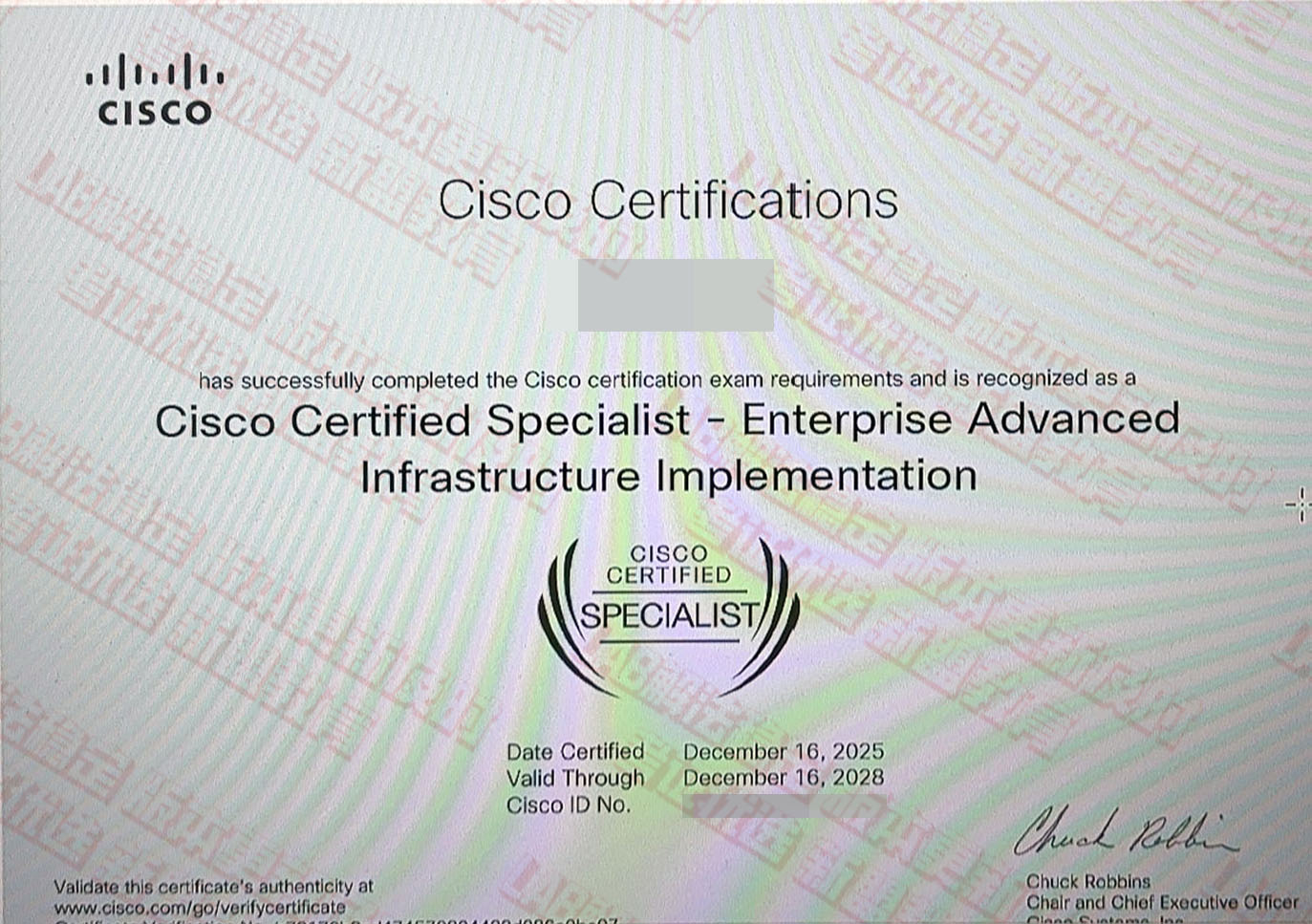
As the "pioneer" of global ICT certifications, the authority of Cisco Certification has stood the test of the market for 30 years and remains the entry benchmark for multinational enterprises and high-end projects. Its certification system features a clear hierarchical structure, covering a complete competency progression path from entry-level CCT, associate-level CCNA, to professional-level CCNP and expert-level CCIE. Among them, CCIE is hailed as the "ultimate honor for network engineers".
The core value of Cisco Certification lies in its technical versatility and international recognition. Cisco equipment still holds a core position in key fields such as multinational corporations, high-end financial institutions, aviation and energy sectors. Holding a Cisco certification means gaining technical recognition across the global IT community. The 2025 certification system has been fully upgraded, with core certifications such as CCNP and CCIE integrating cutting-edge content like SD-WAN, network automation and zero-trust security, fully aligning with the actual needs of enterprises. In terms of salary, certified CCNP professionals in first-tier cities generally earn a monthly salary of 12,000–20,000 RMB, and senior CCIE holders can easily earn an annual salary exceeding 600,000 RMB in foreign-funded enterprises or international projects.
It is clearly suitable for three types of people: practitioners planning to enter foreign-funded enterprises or participate in overseas projects, technology enthusiasts specializing in complex network architectures, and professionals focusing on the operation and maintenance of multinational corporations.
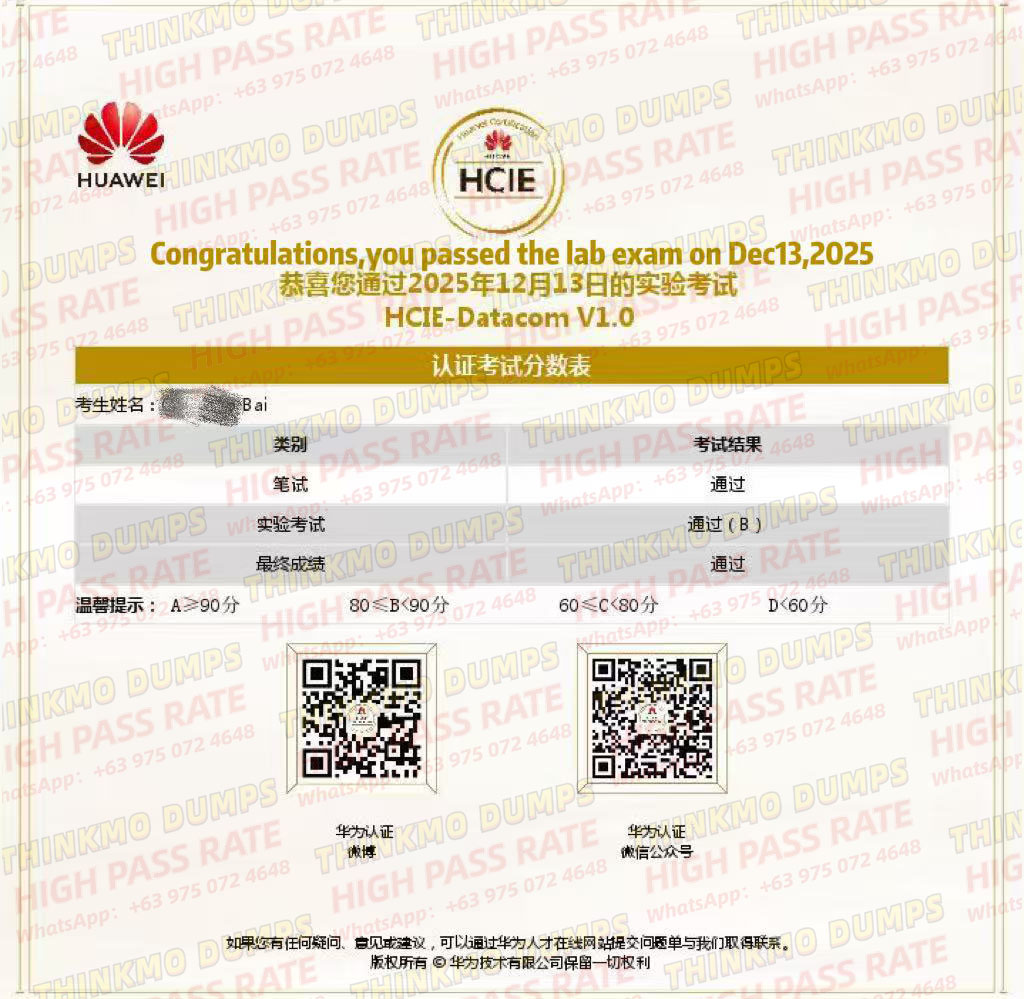
With the wave of localization replacement, Huawei Certification has become the "hard currency" for domestic government and enterprise projects. Its system covers three levels: HCIA (junior-level), HCIP (intermediate-level) and HCIE (expert-level), and continues to expand into new directions. Currently, it encompasses popular fields such as data communication, cloud computing, 5G, HarmonyOS development and Cangjie programming.
The core advantage of Huawei Certification lies in its localized adaptation and policy dividends. Over 80% of domestic government, financial and operator projects adopt Huawei equipment. HCIE certificate holders earn 30% higher salaries than non-certified counterparts in such scenarios, with an average annual salary of 300,000–500,000 RMB. The year 2025 has witnessed multiple upgrades: the HCIA Data Communication V2.0 has added modules such as data center networks and network automation, and the HCIE exam has strengthened practical operations and project practice, continuously enhancing the certificate's gold content. In addition, Huawei has launched a limited-time free retake policy, and some cities offer skill subsidies to certificate holders, further lowering the threshold for exam preparation.
It is suitable for job seekers targeting positions in domestic government, enterprises and operators, trailblazers focusing on the domestic technology ecosystem, and technical personnel looking to quickly adapt to the needs of local projects.
Whether it is Cisco's international standards or Huawei's local ecosystem, ThinkMo provides precisely tailored training support. Founded in 2009, this established institution has served over 180,000 learners with more than 10 years of teaching experience, delivering tens of thousands of IT talents to hundreds of well-known enterprises including Cisco, Lenovo and Google, boasting both excellent reputation and strong capabilities.
ThinkMo's training advantages are comprehensive: as an authorized Huawei HALP training institution, it has in-depth cooperation with official partners such as Cisco and Alibaba Cloud, ensuring formal and reliable qualifications; all instructors are senior experts holding official certifications, with both enterprise project experience and teaching expertise. The courses focus on practical cases, achieving the dual goals of "obtaining certifications + mastering practical skills"; it pioneered one-on-two teaching services, paired with an employment recommendation mechanism, providing full support from exam preparation to job hunting; the course content keeps pace with certification upgrade trends, timely integrating new knowledge points such as Huawei YunshanOS and Cisco network automation, ensuring that what learners acquire aligns with market demands.

The current trend in the ICT industry is not "choosing one over the other", but "complementing multiple certifications". Many hybrid networking projects of leading enterprises require both the international protocol expertise from Cisco certifications and the local equipment operation capabilities from Huawei certifications. Professionals holding dual certifications can enjoy a salary premium of 20%–30%.
The core logic for certification selection lies in career positioning: choose Cisco if focusing on the international market, opt for Huawei if specializing in domestic projects, and prioritize dual certifications if time and budget permit. The key to efficient exam passing lies in selecting professional training support—ThinkMo's customized courses can not only help learners target and break through the high-difficulty lab exams of Cisco CCIE, but also assist in passing all stages of Huawei HCIE (written exam, lab exam and interview), allowing learners to avoid detours.
Certification is an endorsement of technical capabilities, while practical operation is the core of long-term competitiveness. In today's rapidly evolving ICT industry, with the systematic training provided by ThinkMo, transforming the technologies behind certifications into the ability to solve practical problems is the key to truly achieving career advancement.





 1
1  2
2  3
3  4
4  5
5